


Jakarta, July 13, 2026. WE FOR JET called for a fundamental shift in energy transition finance to ensure that people living in remote and off-grid areas are not left behind. The call was delivered by Deden Ramadani, Project Manager of WE FOR JET, during the Fair Finance Asia General Assembly 2026 in Jakarta.
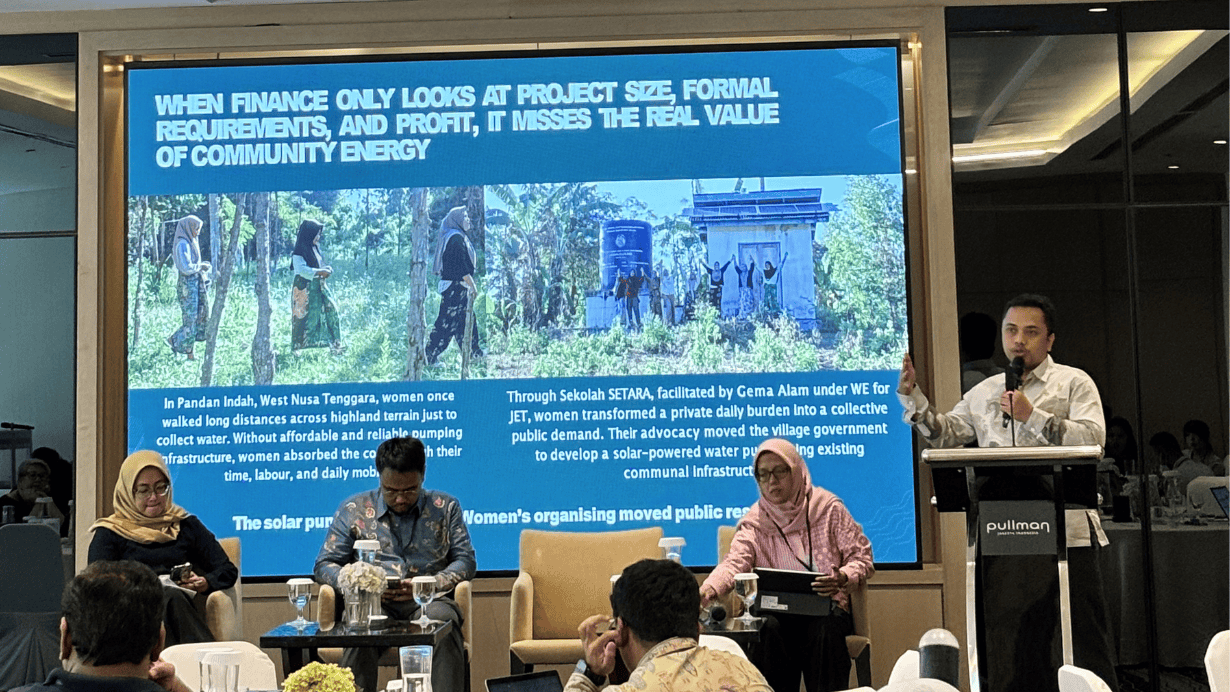
Deden spoke at ResponsiBank Indonesia’s host-country session titled No One Left Off-Grid: Rethinking Finance for a Just Energy Transition. Held at Pullman Jakarta Indonesia Thamrin CBD, the session formed part of the Fair Finance Asia General Assembly, which took place from July 13 to 17, 2026.
Fair Finance Asia is a regional network of more than 90 civil society organizations across Asia. Its annual gathering brings together civil society coalitions, researchers, financial sector advocates, and strategic partners to advance financial systems that work for people and the planet.
In his presentation titled Too Small to Finance, Too Important to Ignore, Deden highlighted a persistent paradox in Indonesia’s energy transition finance. Despite major financing commitments, many communities in remote and off-grid areas still struggle to access financial support.
“Community-based energy projects may appear small in terms of investment size, but their impact is never small. Renewable energy can reduce household expenses, strengthen local businesses, improve community well-being, and ease the unpaid care burden that continues to fall disproportionately on women,” Deden said.
According to Deden, the current financing system remains largely designed for large and centralized projects. As a result, small-scale, distributed, and community-managed energy initiatives are often considered inefficient before their wider social, economic, and environmental benefits are properly assessed.
Financial institutions also tend to prioritize individually owned assets, credit histories, and predictable cash flows. These assessments often fail to recognize collective ownership, local knowledge, community resilience, environmental benefits, and reductions in women’s unpaid care work.
“The problem is not that community energy lacks value. Its value is already visible. The problem is that our financing system continues to use measures that are too narrow to recognize it,” Deden said.
Tangible Impacts at the Community Level
WE FOR JET presented experiences from communities in Eastern Indonesia to demonstrate that energy access is not simply about providing technology. It also affects how time is distributed, how economic opportunities are created, how women participate in decision-making, and how communities exercise control over local resources.
In Pandan Indah Village, West Nusa Tenggara, women previously had to walk long distances across highland terrain to collect water. Without affordable and reliable pumping infrastructure, women absorbed the cost of accessing water through their time, labor, and daily mobility.
Through Sekolah SETARA, facilitated by Gema Alam under the WE FOR JET program, women transformed what had been treated as a private household burden into a collective public demand. Their advocacy encouraged the village government to develop a solar-powered water pump using existing communal infrastructure.
“The solar pump moved the water, but women’s organizing moved public resources. This experience shows that a just energy transition must place communities, especially women, in decision-making roles rather than treating them merely as beneficiaries,” Deden said.
The solar-powered water pump in Pandan Indah is estimated to have reduced the community’s daily cost of accessing water by approximately IDR 60,000. In other areas, renewable energy technologies are supporting local livelihoods in different ways.
In East Flores, for example, solar dryers help improve the quality and selling price of white copra. Coconut shells are also being developed into briquettes, creating an additional source of income. Meanwhile, biogas systems in West Nusa Tenggara provide cleaner energy and produce bio-slurry that can reduce farmers’ dependence on chemical fertilizers.
Based on WE FOR JET’s cost-benefit analysis, every IDR 1 invested across two community energy models is projected to generate approximately IDR 7.28 in social and economic value. A small-scale biodigester using manure from two to three cattle can also produce approximately 1.5 to 2.1 cubic meters of biogas per day, depending on methane content and stove efficiency.
Designing Finance Around Community Realities
Through the Fair Finance Asia forum, WE FOR JET called for an energy transition financing system that no longer requires communities to conform to conventional bankability standards. Instead, financial products and mechanisms should be designed around community realities, local risks, and livelihood patterns.
Financing for community energy could combine grants for early-stage preparation, affordable long-term capital, guarantees, and flexible repayment arrangements that take seasonal livelihoods and local risks into account. Support should also be directed toward cooperatives, women-led enterprises, and collectively owned and managed energy systems.
Financing arrangements must include safeguards against benefits being captured by a small group of powerful actors. They must also ensure that women and marginalized groups have meaningful roles in determining financing priorities, technology choices, ownership models, and benefit distribution.
“A just financing model should not force communities to comply with banking standards that do not reflect their circumstances. Finance itself must be reshaped around community rights, collective ownership, local knowledge, and gender justice,” Deden emphasized.
WE FOR JET’s participation in the Fair Finance Asia General Assembly 2026 reinforced the message that a successful energy transition cannot be measured solely by the volume of investment or the amount of energy capacity installed. A truly just transition must also consider who can access finance, who has the power to shape development decisions, and who ultimately receives the benefits.
For WE FOR JET, ensuring that no community is left off-grid begins with recognizing that community-scale solutions are too important to ignore.