

The first year of WE FOR JET showed that a just energy transition does not begin with technology alone. It begins with people whose voices are often unheard: women, persons with disabilities, village communities, women’s organizations, organizations of persons with disabilities, and civil society actors who are pushing for energy policies to become more inclusive.
From July 2023 to June 2024, WE FOR JET worked with five partners, namely PWYP, Penabulu, Gema Alam, CIS Timor, and YPPS, to strengthen the leadership of women and vulnerable groups in Indonesia’s energy transition.
In its first year, the program directly reached 2,470 people. Of this number, 51.94 percent were women and 4.05 percent were persons with disabilities. More specifically, WE FOR JET reached 1,210 women, 66 women with disabilities, 1,151 men, 34 men with disabilities, 2 boys, and 7 girls. The program also engaged 91 civil society organizations, 12 organizations of persons with disabilities, 16 women’s organizations, 24 local and national media outlets, and 25 private sector actors.
These figures are not only participation achievements. They show that from its first year, WE FOR JET has built an important foundation to shift the way energy transition is understood, from a technical issue into an issue of social justice, economic justice, gender equality, disability inclusion, and governance.
Women Are Entering Village Decision-Making Spaces
One of the important changes took place at the village level. In East Nusa Tenggara, 20 women began participating in village meetings and advocating for their interests, including by pushing for the allocation of 5 percent of village funds for women’s groups. This funding was directed toward various community needs, such as organic fertilizer production, plant-based pesticides, the development of women’s reading spaces, the purchase of horticultural seeds, and the strengthening of women’s organizations.
This change is significant because in many supported areas, decision-making spaces are still strongly influenced by patriarchal norms. Women are often limited to domestic roles and are rarely involved in village development forums. Through GEDSI training, Training of Trainers, and the involvement of village leaders as facilitators, women began to gain space to voice their needs and influence the direction of local development.
The impact was visible in Umbu Ngedo and Waikaninyo Villages, where the involvement of village leaders as facilitators encouraged stronger women’s participation in village development planning meetings. This shows that changing norms requires not only strengthening women’s capacities, but also involving actors who have long held social power in villages.
In its first year, WE FOR JET also strengthened community understanding of the links between unpaid care work, energy, climate, and women’s leadership. Two Rapid Care Analyses in 12 villages in NTB and NTT showed that unpaid care work is still dominated by women and causes women to work longer hours. These findings were then used as advocacy materials for village and district governments.
Renewable Energy Opens New Economic Opportunities
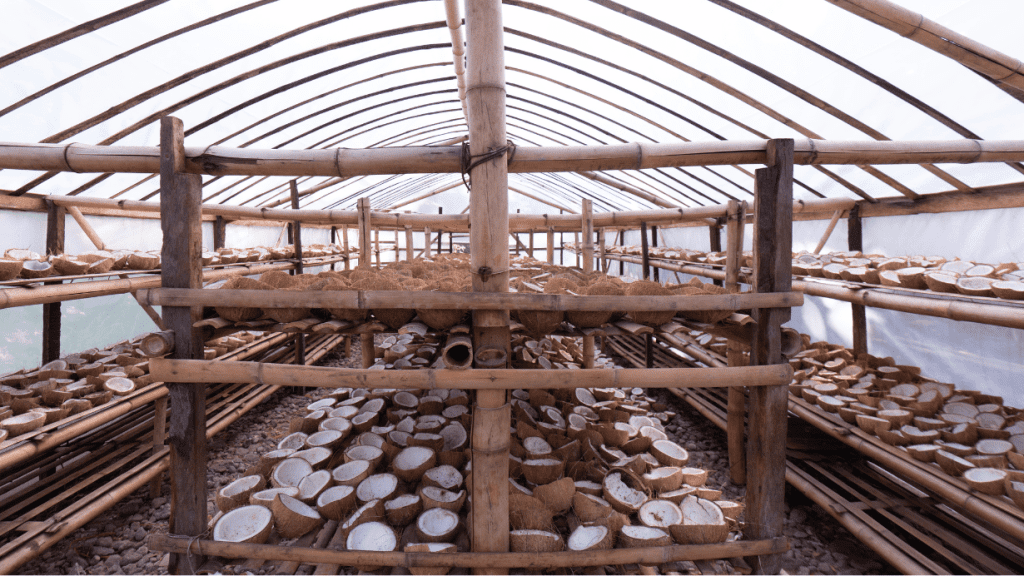
Photo by: Kyo Umareta/Oxfam
The most visible economic impact took place in East Flores, NTT. There, eight women-led productive business groups were established across seven villages. These groups use solar energy through drying houses or solar dryers to produce white copra. By the end of the reporting period, 8 drying houses had been built to support community production.
Before using solar drying houses, copra production depended heavily on direct sunlight. Copra quality often declined due to unpredictable weather, mold, and unstable drying processes. With drying houses, communities can produce better-quality white copra that sells at a higher price.
The impact is concrete. The selling price of copra increased by around 70 percent, from Rp5,000 per kilogram for regular copra to Rp8,500 per kilogram for white copra. During the trial production period from December 2023 to June 2024, communities produced around 25 tons of white copra. From this production, around eight communities recorded total sales of Rp235,000,000, or approximately AUD 23,000.
For communities, these figures show that renewable energy can be directly connected to livelihoods. Solar energy is not only a source of clean energy, but also a tool to increase the value of local products, improve production quality, reduce operational costs, and create job opportunities in villages.
Communities also began processing coconut shell waste into briquettes as an alternative energy source for cooking. This shows that a circular economy model is beginning to grow from community practices. Production waste is no longer seen merely as residue, but as a source of energy and a new business opportunity.
Communities Are Starting to Connect with Markets and the Private Sector
The economic impact of WE FOR JET did not stop at production. Communities also began connecting with market actors. In East Flores, white copra groups were connected with PT Flores Agrojaya Mandiri, a private sector actor that helped open market opportunities for community products.
This connection is important because one of the main challenges for community-based enterprises is market sustainability. Without market access, renewable energy innovations often stop at the pilot stage. With initial links to the private sector, communities have a greater opportunity to strengthen value chains, improve production standards, and expand their buyer base.
In addition, the program also produced several studies to strengthen market and financing strategies. In NTB and NTT, WE FOR JET supported the development of private sector mapping documents, supply chain and market studies, and mapping of funding opportunities for energy transition and renewable energy. These studies helped communities and partners identify actors that could support production, distribution, financing, and the expansion of locally based renewable energy enterprises.
In this way, the first-year impact was not only about increased production, but also about the emergence of an early ecosystem connecting communities, government, the private sector, and civil society organizations.
Persons with Disabilities Are Becoming More Visible in the Energy Transition
In its first year, WE FOR JET engaged 13 organizations of persons with disabilities from local to national levels. In addition, 4.05 percent of direct participants were persons with disabilities.
In NTB, Gema Alam used the Washington Group Questionnaire to identify persons with disabilities and integrate the data into village advocacy processes. The results began to show. Data on persons with disabilities was included in the profiles of Tete Batu Selatan Village and Rarang Village. Pandan Indah Village followed up on this process by allocating Rp1,000,000 for the purchase of hearing aids.
This is an important example of how data can change small-scale policies at the village level. When persons with disabilities are not recorded, their needs are often excluded from planning. However, when data is available and used in advocacy, villages begin to have a basis for allocating budgets and providing more appropriate support.
WE FOR JET also encouraged the participation of persons with disabilities in village forums, training, and community production. In East Flores, two persons with disabilities were involved in white copra production and earned additional income from the activity. At the national level, PWYP worked with HWDI to build a campaign on the importance of the participation of persons with disabilities in energy transition policy processes.
Civil Society Coalitions Are Growing Stronger
The first year of WE FOR JET also generated important impact in strengthening civil society movements. At the national level, the JET Coalition was formed, consisting of 11 civil society organizations and 4 women’s organizations, including Oxfam. This coalition has been active in energy transition discussions and engaged with the Indonesia JETP Secretariat.
PWYP, as one of the key actors in the coalition, began to be more frequently invited to provide input on GEDSI in energy transition discussion spaces. PWYP was invited to 2 JETP activities, EITI Indonesia activities, the ASEAN Disability Forum, Fair Finance Asia, and IESR, and received an Australia Awards Indonesia short course scholarship for the program “Mainstreaming GEDSI in Indonesia’s Energy Transition”.
At the provincial level, Penabulu initiated the GEDSI JET Working Group in NTB. This working group later played a role in encouraging the integration of GEDSI into West Nusa Tenggara Governor Regulation Number 13 of 2024 on Green Energy and contributed to the development of technical guidelines for GEDSI implementation with the government. One Penabulu representative in NTB was also appointed as an energy sector expert in the preparation of the Regional Long-Term Development Plan.
Meanwhile, in NTT, CIS Timor facilitated the reactivation of a multi-stakeholder forum that brought together government and civil society to promote GEDSI issues in the revision of the Regional Energy Plan. Through stakeholder mapping in NTT, 32 pentahelix institutions were mapped into four groups: supply, demand, supporting system, and people we work with. This mapping became a basis for accelerating the formation and strengthening of the GEDSI working group in the energy transition.
GEDSI Narratives Are Beginning to Enter Energy Policy
One of the biggest achievements of WE FOR JET in its first year was the inclusion of recommendations from civil society, women’s organizations, and organizations of persons with disabilities in energy policy.
On 20 November 2023, the Indonesia JETP Secretariat adopted inputs from the CSO and WRO coalition into the 2023 Comprehensive Investment and Policy Plan, particularly sections 6.2.2.1 and 7.2.1, which relate to economic justice in the development of community-based renewable energy at the local level.
At the provincial level, the NTB Energy and Mineral Resources Agency incorporated inputs from the GEDSI JET Working Group into West Nusa Tenggara Governor Regulation Number 13 of 2024 on Green Energy. This regulation is significant because NTB is referred to as the first province in Indonesia to have a renewable energy development regulation with a GEDSI approach.
This achievement shows that WE FOR JET’s advocacy did not stop at campaigns or dialogue. Inputs from civil society began to be translated into policy documents that can serve as references for more inclusive energy development.
Digital Impact: Just Energy Transition Enters the Public Space
In addition to working in communities and policy spaces, WE FOR JET also expanded the narrative of a just energy transition through digital campaigns. Throughout the first year, the program produced 20 campaign contents on energy transition, GEDSI, and good practices in community-based renewable energy. These contents included social media posts, campaign videos, and podcasts with women’s organizations and organizations of persons with disabilities.
From trackable content, the campaign generated 3,402 likes, 166,011 impressions, and 126,699 reach. On Instagram, the engagement rate reached 3.75 percent, with an average of 105 likes and 3 comments per post.
These figures are important because energy transition is still often seen as a technical and elite issue. Through digital campaigns, WE FOR JET began introducing a narrative that just energy is also connected to care work, women’s leadership, disability inclusion, local economies, and citizens’ rights to participate in decision-making.
Foundations of Change in the First Year
In summary, WE FOR JET’s impact in 2023–2024 can be seen through several key changes.
First, the program directly reached 2,470 people, with women representing 51.94 percent and persons with disabilities representing 4.05 percent.
Second, women began entering village decision-making spaces, including 20 women in NTT who advocated for the allocation of 5 percent of village funds for women’s groups.
Third, eight women-led productive business groups in seven villages began using solar energy for white copra production, supported by 8 drying houses.
Fourth, the economic value of community products increased, with copra prices rising by around 70 percent, trial production reaching 25 tons, and total community sales reaching Rp235 million from December 2023 to June 2024.
Fifth, disability issues began entering village planning through disability data collection, village fund allocation for hearing aids, and the participation of persons with disabilities in community production.
Sixth, civil society coalitions grew stronger, including the formation of the national JET Coalition and the GEDSI JET Working Group in NTB.
Seventh, civil society recommendations began entering policy documents, including the 2023 CIPP and West Nusa Tenggara Governor Regulation Number 13 of 2024 on Green Energy.
A First Year That Opened the Way Forward
WE FOR JET 2023–2024 shows that a just energy transition requires more than infrastructure. It requires evidence, community leadership, women’s courage, the participation of persons with disabilities, government support, market access, and strong civil society coalitions.
In its first year, the program proved that renewable energy can strengthen village economies, open spaces for women’s leadership, integrate GEDSI into policy, and amplify community voices in the national energy transition agenda.
From the 2,470 people reached, the 8 drying houses built, the 25 tons of white copra produced, the Rp235 million in community sales, to the inclusion of GEDSI recommendations in energy policy, WE FOR JET delivers one important message: a truly just energy transition must begin with those who are closest to its impacts.