

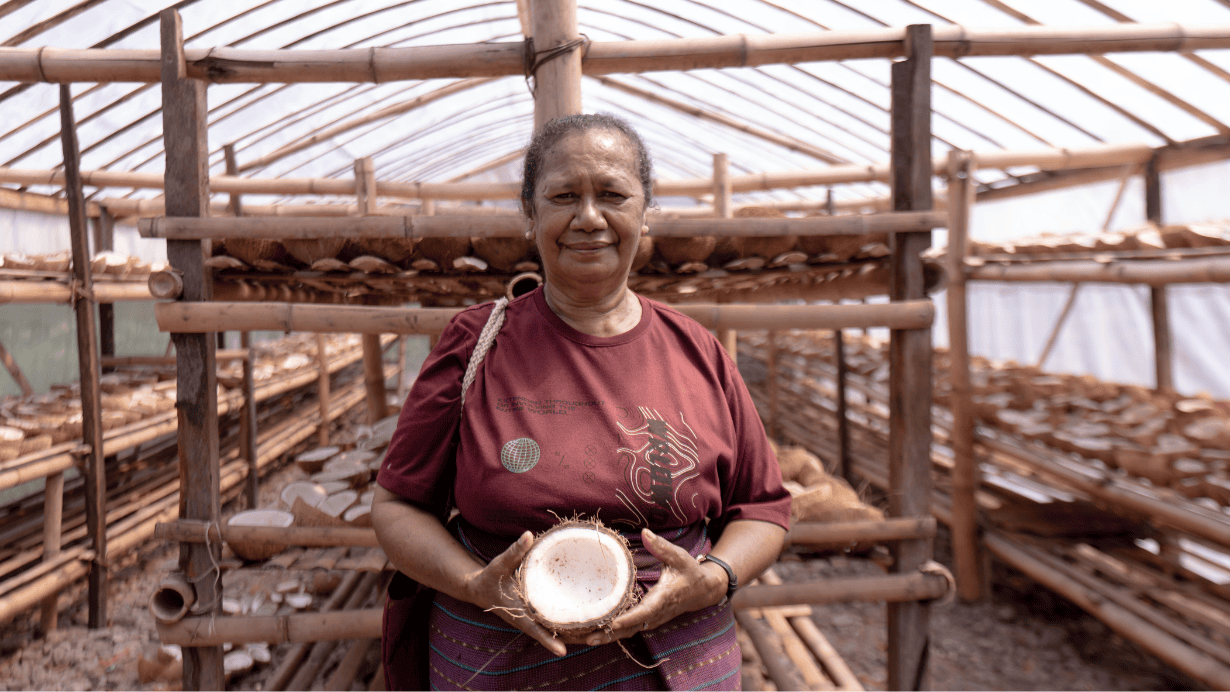

Beneath the swaying coconut palms of East Flores, a quiet but powerful transformation is taking place. For farming communities in Homa, Bantala, and Serinuho villages, coconut trees have long been central to daily life and local livelihoods. For generations, families have processed coconuts into traditional cooking oil and white copra. Yet one persistent challenge remained: mountains of discarded coconut shells, often left as waste or burned openly, contributing to air pollution.
Through the WE FOR JET initiative, implemented by the Yayasan Pengkajian dan Pengembangan Sosial (YPPS) in Larantuka, East Flores, communities have begun to see this agricultural waste differently. Under the community-based “Sekolah Kelapa” (Coconut School) programme, discarded coconut shells are now transformed into charcoal briquettes—an environmentally friendly alternative fuel that not only reduces waste but also helps free women from smoke-filled kitchens.
Turning Waste into “Black Gold”
The energy transition began with a simple idea: making better use of local resources.
Community groups, including Mala Ti in Homa Village, Wolosina Watoboki in Bantala Village, and Waimatan in Serinuho Village, received hands-on training to collectively produce charcoal briquettes from coconut shells.
The production process uses a drum-based carbonization method known locally as Arang Mati Hampa—a low-oxygen combustion technique that produces high-quality porous charcoal with minimal smoke and excellent heat efficiency. The process is straightforward and can easily be replicated by community members:
- Coconut shells are carbonized inside metal drums.
- The charcoal is crushed and sieved into a fine powder.
- The powder is mixed with a natural starch binder made from cassava flour.
- The mixture is molded into briquettes and dried in community drying houses until hardened.
“It only takes cassava starch and charcoal to produce something truly useful,” said Yosep N. Assan, affectionately known as Om Yordan, Secretary of the Mala Ti Community in Homa Village.
Smoke-Free Kitchens, Healthier Lives
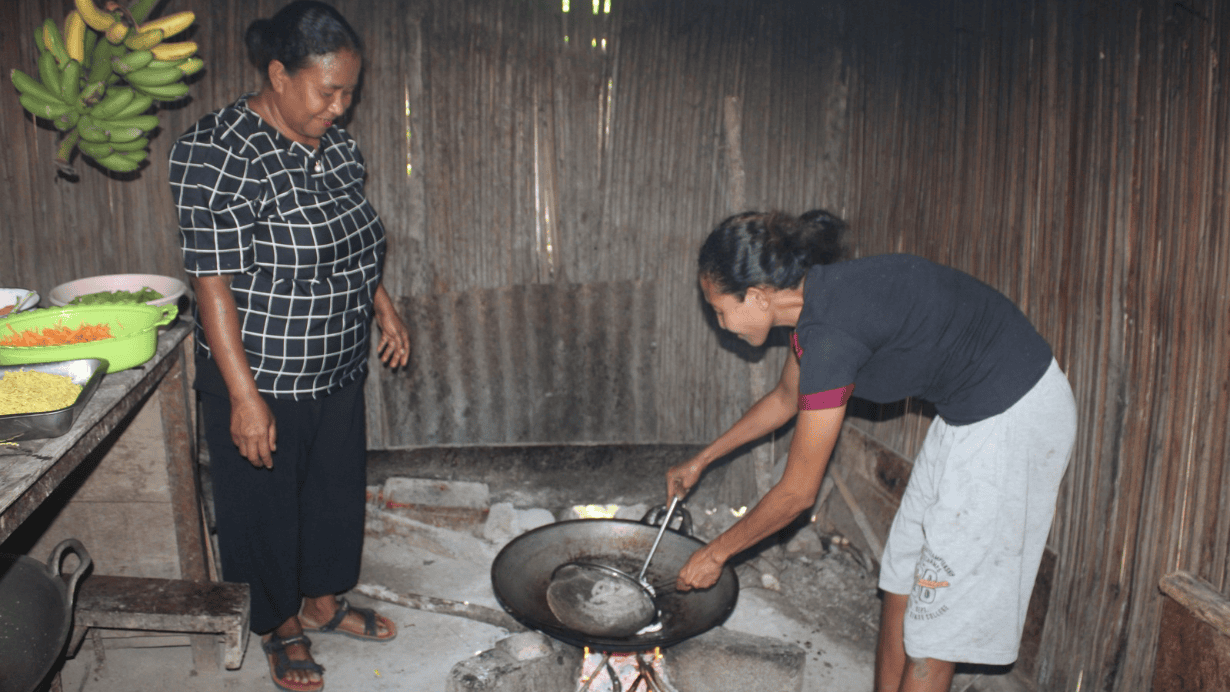
For women in rural communities, the introduction of charcoal briquettes has transformed one of the most demanding aspects of daily life: cooking.
For decades, preparing meals meant enduring thick wood smoke that irritated the eyes, damaged the lungs, and made cooking physically exhausting.
Lusia Loun Sogen, known locally as Mama Lus, has been a coconut farmer in Bantala Village since 1989. She recalled how difficult life used to be.
“Before we learned about briquettes, I had to walk into the forest every two days just to collect firewood. During the rainy season, the wood was always wet, producing thick smoke that made our eyes sting and caused constant coughing. Today, with portable briquette stoves, everything has changed. Our kitchen used to be filled with smoke; now it is filled with hope.”
The benefits are clear. Briquettes produce a steady flame, generate very little smoke, burn for two to three hours, and significantly reduce cooking time while creating a much healthier cooking environment.
Strengthening Household Economies and Community Resilience
Beyond health improvements, charcoal briquettes have also reduced household energy costs.
As kerosene becomes increasingly expensive and difficult to obtain, coconut-shell briquettes provide an affordable and locally available alternative.
In Serinuho and Bantala villages, average kerosene consumption has been cut in half—from approximately 10 litres per month to only 5 litres. In Homa Village, the savings are even greater, with many households rarely needing kerosene at all.
The money saved is now being redirected toward essential household needs, including children’s education.
The initiative has also created new economic opportunities.
Under the leadership of Remigius Liwun in Bantala Village, the Wolosina Watoboki Community has expanded production beyond household use. Their charcoal and briquettes are now sold to local micro and small businesses, including street food vendors and traditional cake producers.
Part of the income generated is deposited into a shared community fund.
“When one of our members struggles to pay school fees for their children, the community fund can help. It also supports equipment maintenance and production costs. We are not only producing charcoal—we are strengthening one another,” Remigius explained.
The savings group (Saving and Internal Lending Community/SILC), established through YPPS, is now fully managed by women in the community, further strengthening local leadership and economic resilience.
Fueling Hope for the Future
Challenges remain. Production equipment is still basic, production capacity is limited, and access to broader markets needs to be expanded. Nevertheless, community investments such as the Rumah Energi Matahari (Solar Energy House) in Serinuho Village demonstrate a long-term commitment to local energy independence.
The experience of these three villages offers an important lesson: a just energy transition does not always require expensive or sophisticated technology. With local knowledge, collective action, and the sustainable use of available resources, agricultural waste can become an opportunity to improve livelihoods, protect the environment, and strengthen communities.
Across East Flores, coconut shells are no longer viewed as waste. They have become a source of cleaner energy, healthier homes, and renewed optimism.
The communities themselves perhaps express it best: they are no longer simply burning wood—they are fueling hope for a future that is cleaner, more resilient, and brighter for everyone.
Written by Nurjanah, WE FOR JET Provincial Coordinator, Yayasan Penabulu.