


This IDR 815 billion programme must be assessed through more than foreign-exchange calculations. It must also be tested against the principles of a just energy transition.
The proposed electric stove conversion programme has once again sparked public debate. Two recent Tempo reports, “Can the Shift to Electric Stoves Reduce LPG Subsidies?” and “How to Prevent the Electric Stove Conversion Programme from Failing,” capture many of the concerns surrounding the policy.
At the heart of the debate lies a fundamental question: are electric stoves genuinely part of Indonesia’s energy transition, or are they simply a tool for replacing imported fuel?
This is not merely a rhetorical question. It must be answered before any portion of the IDR 815.56 billion budget planned for next year is spent. If the programme primarily replaces imported LPG with electricity generated from domestic coal, then what is being presented as an energy transition may, in practice, be little more than a fiscal policy wrapped in the language of clean energy.
The Ministry of Energy and Mineral Resources has justified the programme primarily as a way to reduce Indonesia’s dependence on imported LPG and protect foreign-exchange reserves. During a working meeting with Commission XII of the House of Representatives on 15 June 2026, Minister of Energy and Mineral Resources Bahlil Lahadalia stated that imports currently supply approximately 80 per cent of national LPG demand.
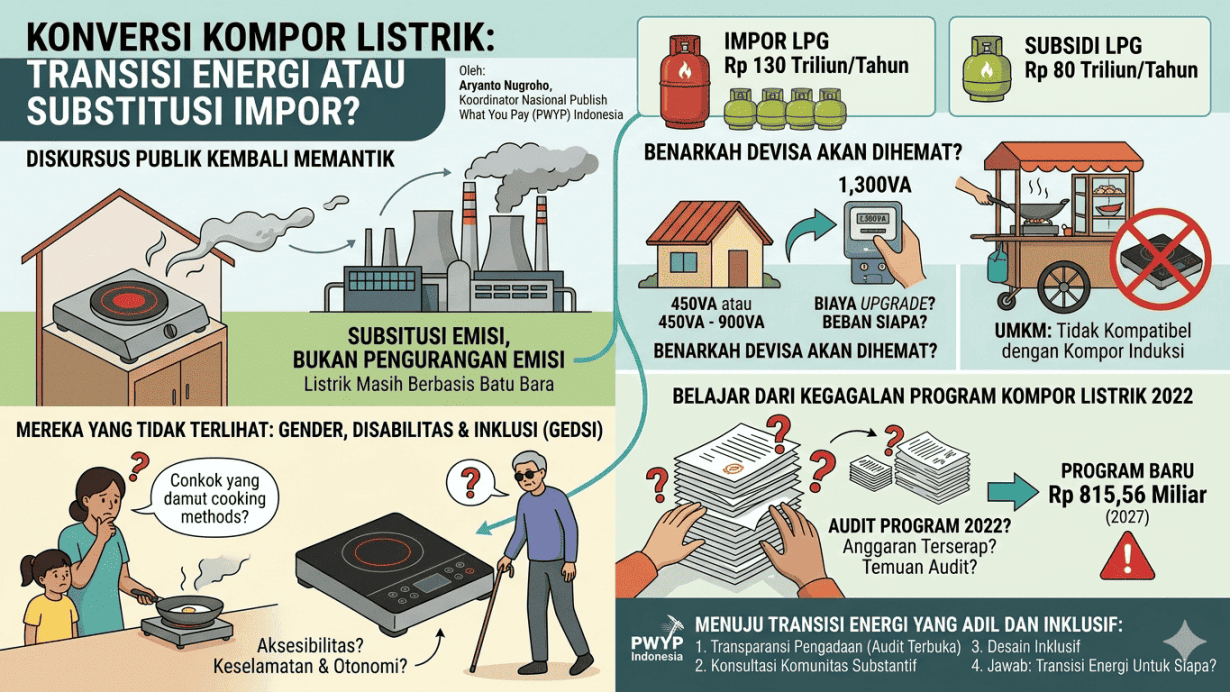
The financial burden is substantial. LPG imports reportedly cost the country around IDR 130 trillion in foreign exchange each year, while subsidies add another IDR 80 trillion annually.
The fiscal argument is valid. Reducing dependence on imported energy is a reasonable policy objective. However, good intentions do not automatically result in good policy.
Replacing Emissions Rather Than Reducing Them
A just energy transition has a clear meaning: moving from more polluting energy sources toward cleaner ones while ensuring that the costs and risks of the transition are not unfairly imposed on particular communities.
It is not simply about replacing one form of dependence with another.
More than half of the electricity generated within the PLN system still comes from coal-fired power plants. This means that induction stoves used today are still largely powered by fossil fuels.
Replacing imported LPG with electricity produced from domestic coal may improve Indonesia’s balance of payments, but it does not necessarily lead to a meaningful reduction in emissions.
This is not yet an energy transition. It is a substitution of emissions.
Claims that electric stoves form part of Indonesia’s clean energy agenda can only be justified if they are accompanied by something that remains absent: a concrete and time-bound roadmap for decarbonizing the electricity system.
When will the share of renewable energy in the national grid reach a level at which cooking with electricity becomes demonstrably cleaner than cooking with LPG?
Without a clear answer, the claim that electric stoves support the energy transition risks becoming little more than policy marketing.
Will the Programme Really Save Foreign Exchange?
The projected foreign-exchange savings should be assessed in full, including costs that are often excluded from government calculations.
Many low-income households currently have electricity connections of only 450 VA or 900 VA, while induction stoves generally require at least 1,300 VA.
If these households become the programme’s primary target, their electricity capacity may need to be upgraded before they can use the stoves.
If the cost of upgrading is not covered by the programme, it will become a direct financial burden on recipients, many of whom are already economically vulnerable.
If the government covers the cost, electricity subsidies may increase and replace the LPG subsidies that the programme is intended to reduce.
Under either scenario, the promise of savings must be explained more honestly: savings for whom, and at whose expense?
There is also another group of subsidized LPG users who are frequently overlooked in programmes of this kind: mobile vendors and home-based microenterprises.
For meatball sellers, fried-food vendors, and roadside food stalls, LPG is not simply a household cooking fuel. It is a production input that must be portable and used in locations where electricity may not be available.
For these businesses, electric stoves are not only impractical because power outlets are often unavailable. Much of their existing cookware, including curved aluminium woks, may also be incompatible with induction technology.
A programme that fails to identify and understand these users from the outset will not only be ineffective. It may threaten the livelihoods of the very groups that public policy should protect.
Those Who Remain Invisible in the Programme’s Design
Two other groups are consistently absent from the planning of programmes like this, even though they interact with cooking equipment more than almost anyone else.
The first is women.
In low-income and vulnerable households, women are often the primary users of cooking stoves. They are the ones who experience the direct consequences of changes in equipment, energy costs, cooking methods, and household routines.
Yet there appears to be no dedicated consultation mechanism designed to capture their experiences and concerns.
Women heading households in fishing villages, homemakers in densely populated urban neighbourhoods, and women running microenterprises where cooking is part of the production process will all be directly affected.
They are among the programme’s most important users, but also among those least likely to be heard.
A just transition requires them to be treated not as passive recipients of equipment, but as participants whose knowledge and experience shape the policy from the beginning.
The second group is persons with disabilities, particularly people who are blind or have limited mobility.
Many modern induction stoves rely on flat touchscreen interfaces without physical buttons, audio feedback, or adequate tactile markers.
For blind users, this is not merely inconvenient. It concerns personal safety and the ability to cook independently.
The freedom to prepare one’s own food without relying on others is part of personal dignity and autonomy.
A programme that distributes electric stoves without minimum accessibility standards does not merely fail to serve persons with disabilities. It actively excludes them from the benefits of a public programme funded by all taxpayers.
GEDSI principles—gender equality, disability inclusion, and social inclusion—must not be treated as decorative language in a planning document.
For the electric stove programme, GEDSI should become a technical procurement requirement.
Every stove distributed should meet mandatory minimum accessibility standards. Community consultations should also be designed to proactively reach women, persons with disabilities, and other marginalized groups, rather than expecting them to attend forums that were never designed around their needs.
Learning from the Failure of the 2022 Electric Stove Programme
Before launching another programme, an important issue remains unresolved.
The 2022 electric stove conversion programme was cancelled after facing widespread public resistance. However, the public has never received a complete account of what happened.
How much of the budget had already been spent? How was the procurement process conducted? Was the programme audited, and what were the final audit findings?
The cancellation of a programme does not eliminate the obligation to account for public spending.
The failure of the 2022 programme was not simply the result of poor communication or unexpected resistance. It reflected systemic weaknesses.
The programme was designed without meaningful consultation with recipient communities, without an honest assessment of infrastructure readiness, and without an effective mechanism for correction when concerns began to emerge from the field.
Community resistance was treated merely as a communication obstacle rather than as important policy information requiring a substantive response.
Launching a new IDR 815 billion programme without resolving the accountability issues of the previous programme would set a dangerous precedent for public governance.
The audit of the 2022 programme should become a mandatory reference document before any new electric stoves are procured or distributed.
Preventing Old Injustices from Returning in New Forms
Publish What You Pay Indonesia does not oppose the objectives of the programme.
Reducing Indonesia’s dependence on imported LPG is a legitimate goal. Addressing subsidy systems that have not always reached the intended recipients is also necessary.
However, public financing that lacks transparency, programmes that exclude vulnerable groups, and policies developed without meaningful participation from those most affected will simply reproduce old injustices in a new form.
Trillions of rupiah may be spent in the name of clean energy and fiscal efficiency, while the underlying pattern remains unchanged: powerful institutions make the decisions, while vulnerable communities bear the consequences.
The electric stove programme could become a meaningful, although modest, step toward a cleaner and more resilient energy system.
But this will only happen if it is built on transparent procurement that can be independently audited, substantive community consultation, accessible design for persons with disabilities and vulnerable groups, and a willingness to answer the most fundamental question:
Who is this energy transition really for?
Note:
This article was first published on Indonesiana under the title “Government Transparency and a Just Energy Transition.”
Written by Aryanto Nugroho, National Coordinator of Publish What You Pay Indonesia.