

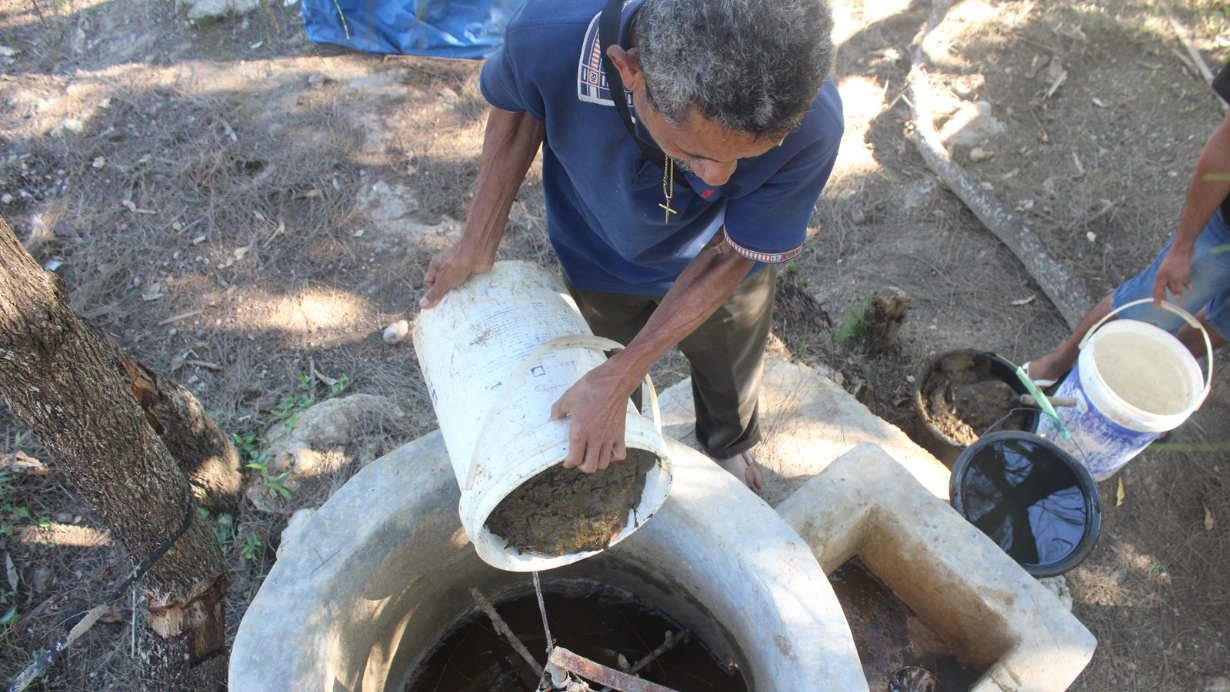
At daybreak, Ferderika Kalepao returns home carrying two buckets filled with cattle manure. She has spent the morning collecting it from the grazing fields surrounding her village in Nenas, South Central Timor (TTS), East Nusa Tenggara.
Waiting in the backyard is her husband, Christian Eduard. Together, they mix one bucket of manure with one bucket of water before pouring the slurry into a biodigester buried beneath the ground. Inside the underground chamber, naturally occurring bacteria break down the organic waste through anaerobic fermentation, producing methane gas.
A 27-metre pipeline carries the gas directly into their kitchen.
Ferderika turns the knob on her stove.
A blue flame appears instantly.
For her family, this simple moment represents something extraordinary.
“We never imagined that something like a gas stove could exist in our home. We thought those belonged only in big cities.”
Renewable Energy at the Foot of Mount Mutis
Nenas Village lies on the slopes of Mount Mutis, the highest mountain in West Timor. Located approximately 155 kilometres from Kupang, the journey is long and difficult, with steep, rocky roads that many residents jokingly call “the road to hell.”
The village sits behind Mutis Timau National Park, where geographical isolation has limited infrastructure development. Electricity has yet to reach many households, telecommunications are unreliable, and access to modern energy services remains extremely limited.
It is in this context that the WE FOR JET programme, implemented by the Circle of Imagine Society (CIS) Timor, introduced community-based biogas systems.
The initiative focuses not only on expanding renewable energy access but also on strengthening women’s leadership in community energy solutions.
Turning Livestock Waste into Clean Energy
The biogas system makes use of one resource that Nenas has in abundance: cattle manure.
Nearly every household raises cattle, making the raw material freely available.
Constructing the biodigester required an initial supply of approximately eight pickup truckloads of manure, collected from family-owned cattle sheds, neighbouring farms, and nearby grazing fields.
After about one week of fermentation, the system begins producing enough methane to fuel a household stove.
From then on, maintaining the system requires only two buckets of fresh manure every two or three days.
“It turns out that something we always considered waste has incredible value,” Ferderika said.
According to Haris A. C. H. Oematan, Director of CIS Timor, the idea emerged after the organization conducted a renewable energy assessment in the village.
The survey revealed enormous untapped potential for biogas because almost every family already owned cattle.
Working alongside community members and technical experts from a university in Kupang, CIS Timor completed the pilot biodigester with an investment of approximately IDR 15.7 million.
Much of the cost covered construction materials—including cement, bricks, and sand—which had to be transported into the remote village. Community members contributed labour through collective volunteer work, significantly reducing overall expenses.
Lower Energy Costs, Greater Resilience
The economic benefits were immediate.
Before installing biogas, Ferderika’s family of eleven relied heavily on kerosene for cooking.
A household their size could consume up to five litres every day. In Nenas, kerosene costs around IDR 10,000 per litre—more than twice the national retail price—and transporting fuel into the village adds even more expense.
Now, those costs have been dramatically reduced.
Unlike LPG or kerosene, the fuel source is produced entirely within the community.
“The investment can last for decades with proper maintenance,” Haris explained. “It is affordable, locally available, and environmentally sustainable.”
Protecting Forests While Supporting Agriculture
The benefits extend well beyond household energy savings.
Before biogas, families also depended heavily on firewood collected from nearby forests. As the population grew, increasing demand for fuelwood placed additional pressure on the forests surrounding Mount Mutis—one of West Timor’s most important water catchment areas.
By reducing the need for firewood, biogas helps ease pressure on these ecosystems while contributing to climate change mitigation through cleaner household energy.
The biodigester also produces a valuable by-product.
The nutrient-rich slurry remaining after fermentation is applied as organic fertilizer, replacing chemical inputs in household gardens.
Today, the family grows tomatoes, potatoes, carrots, spring onions, chilli peppers, bananas, betel vines, and coconuts using organic fertilizer generated by the biogas system.
“The biogas has reduced our household expenses,” Christian said. “At the same time, our harvests have improved, and everything is grown without chemicals. Honestly, we never imagined our lives could change like this.”
A Model for Community Energy Transition
Encouraged by these results, CIS Timor plans to replicate the biogas model in neighbouring villages around Mount Mutis and across other parts of Timor with similar livestock resources.
The organization is also exploring opportunities to expand biogas beyond cooking fuel, including its potential to generate electricity. This would complement the village’s existing solar energy systems, which often struggle during long periods of rain and cloudy weather.
For families like Ferderika’s, however, the transformation is already profound.
The visit ends with a shared lunch prepared entirely on the biogas stove. The chicken soup and traditional luat chilli sambal are cooked using methane produced from cattle manure, while many of the fresh vegetables come from gardens nourished by organic fertilizer generated through the same system.
What once seemed impossible has become part of everyday life.
The energy transition is no longer something discussed only in international conferences or policy forums. In Nenas Village, at the foot of Mount Mutis, it burns quietly in the kitchens of women like Ferderika—demonstrating that locally driven renewable energy solutions can improve livelihoods, strengthen resilience, and build a cleaner future from the ground up.