


Stories of Change from the First Year of WE for JET in East Nusa Tenggara
In several villages in East Nusa Tenggara, change often comes slowly. It does not always appear as a new regulation, a project signboard, or a building standing in the middle of the village. Sometimes, it begins with something that seems small: a father taking his child to the integrated health post, a husband starting to fetch water, a woman daring to speak in a village planning meeting, or a child with a hearing disability finally agreeing to join a community activity.
From the outside, these changes may seem simple. But in villages where, for years, life has been divided clearly between what men do and what women do, even simple acts can signal that something is beginning to shift.
The WE for JET Program, implemented by Oxfam in Indonesia and CIS Timor from August 2023 to June 2024, worked in six villages across East Nusa Tenggara Province. Three villages are located in South Central Timor Regency: Mutis, Nenas, and Pene. The other three are in Southwest Sumba Regency: Loko Kalada, Waikaninyo, and Umbu Ngedo.
In its first year, much of the program’s work focused on one fundamental issue: building awareness.
Awareness that a just energy transition is not only about electricity, solar panels, or new energy sources. It is also about who carries the heaviest workload when energy is limited. Who walks to collect water. Who gathers firewood. Who cooks, washes, cares for children, looks after family members, and yet is rarely present in decision-making spaces.
In many of the supported villages, the answer is still often the same: women.
Women are responsible for many domestic tasks. They cook, wash, fetch clean water, care for children, and carry out unpaid care work. At the same time, their access to information and knowledge remains limited. When villages discuss development, energy, climate, or budgets, women are not always present as voices to be heard.
Persons with disabilities face another layer of vulnerability. They are often seen as powerless, and therefore are rarely involved in meetings or placed in group structures. Yet if an energy transition is called just, that justice should also reach them.
From there, small acts of change began.
In Pene Utara, Equality Began at the Well
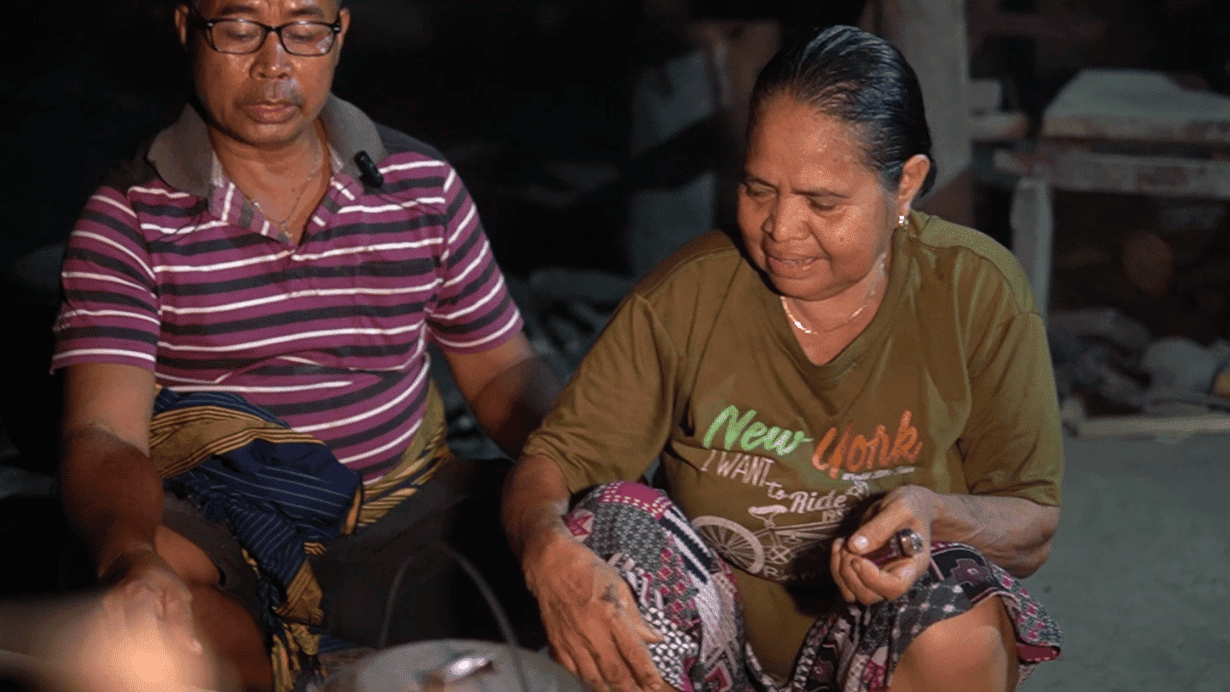
In Pene Utara Village, South Central Timor Regency, Mr. Danial Batmalo is known as one of the local drivers of gender equality. He is not new to village affairs. Before CIS Timor entered Pene Utara, he had already been involved in managing the Village-Owned Enterprise (Badan Usaha Milik Desa, BUMDes) and had received training on gender.
But Pene Utara is not an easy village to change.
According to Mr. Danial, the social system in Pene Utara is still strongly influenced by old traditions. In the past, leading roles such as commander, elder, and king were always held by men. Women were placed at the back. That way of thinking carried over into everyday community life.
Mr. Danial uses a sharp expression to describe women’s position in that culture: women were treated as if they were “not even allowed to open the curtain of the middle door of the house.”
It may sound like a simple phrase. But behind it lies a long history of who is allowed to appear in front, who is expected to remain silent, who is trusted to lead, and who is considered fit only to work behind the house.
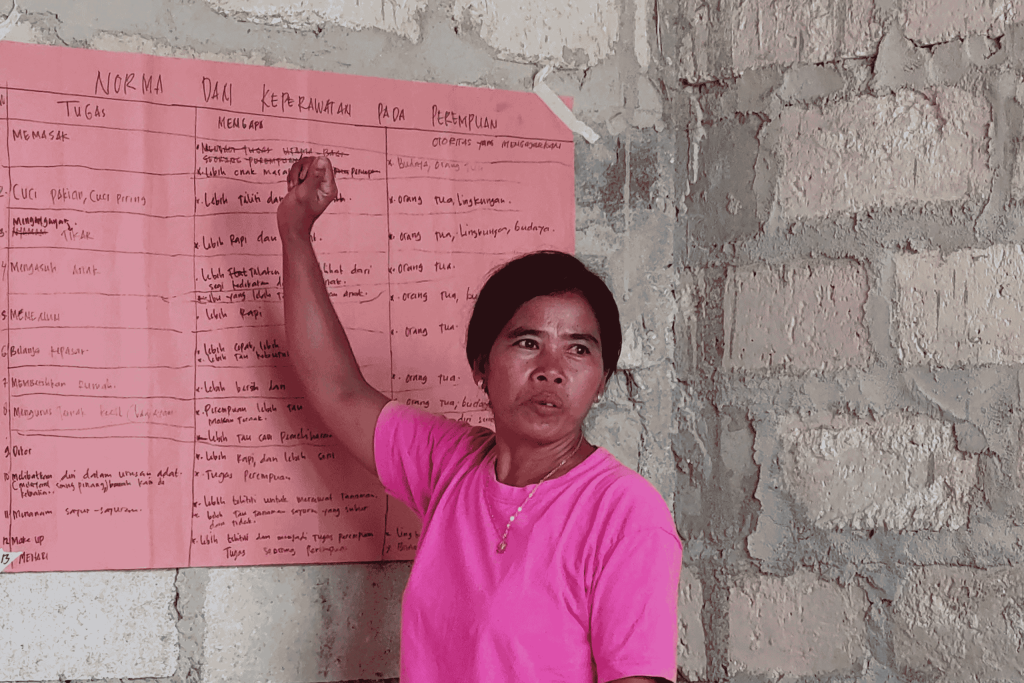
Around November 2023, CIS Timor, through WE for JET, trained prospective village facilitators through a Training of Trainers on Gender Equality, Disability, and Social Inclusion (GEDSI) and Just Energy Transition (JET). In coordination with the village government, several prospective facilitators were selected from community members and village officials. Mr. Danial was one of them.
The training strengthened his belief that equality should not only be discussed in training rooms. It must be practiced.
“There have been small changes, such as fathers taking their children to the integrated health post, not only their wives anymore,” said Mr. Danial.
That small change began with himself. He collected firewood. Washed clothes. Bathed children. Fetched water. These were tasks that had long been seen as women’s work.
He once recalled that while staying at his in-laws’ house, he helped fetch water from the well. His neighbors and mother-in-law reprimanded him.
“That is women’s work. It is embarrassing if people see you.”
But he kept fetching the water.
In Pene Utara, the well became more than just a place to collect water. It became a place where the line between “men’s work” and “women’s work” began to be questioned. From that small act came a larger message: household work is not women’s destiny. It is a shared responsibility.
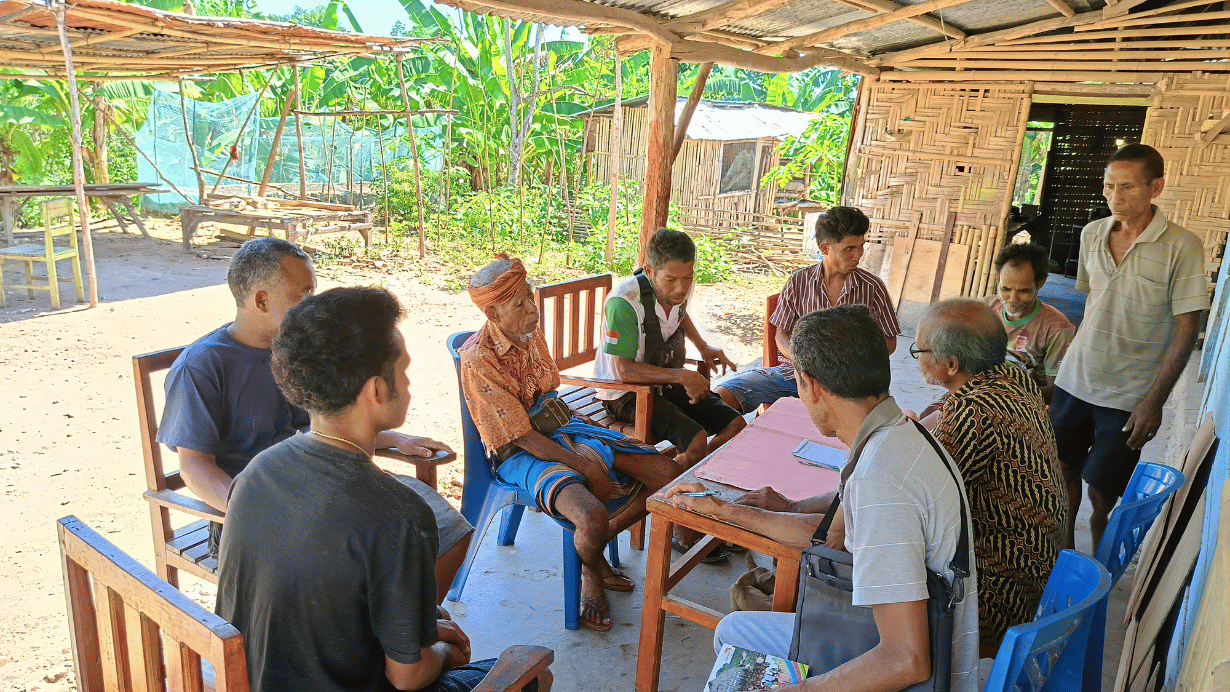
A similar push also came from a customary leader. At the end of a Focus Group Discussion for the Rapid Care Analysis, a customary leader who is also a king said that those who had understood the issue must go down to the community.
“To change things completely, we are the representatives who must go into the community to motivate people. If all tasks are still done in the same way, it means we are still living in the culture and condition of the past. So our duty and responsibility is to share this with the community.”
In Pene Utara, change did not come from one person alone. It began to become a shared conversation: at home, in forums, in customary spaces, and in the village.
In Umbu Ngedo, Curiosity Became a Women Farmers’ Group
In Umbu Ngedo Village, CIS Timor’s initial activities raised questions among the community. Why did the training separate women and men? What was the purpose of discussing the division of household labor? Why was energy being discussed together with women’s issues?
Curiosity slowly turned into interest.
Through the Rapid Care Analysis, participants were invited to calculate and compare the workload of women and men in the household. From that process, it became clear that women carried more work. They worked longer hours, but much of their work was not recognized as productive work.
The Acting Head of Umbu Ngedo Village saw CIS Timor’s activities as a way to balance the traditions that exist in the community. For him, household work should not be placed only on women. Men also need to take part.
From that process, another change emerged. The WE for JET Program inspired the formation of a women farmers’ group. The group later called itself the CIS Timor Women Farmers’ Group. The village government appreciated this initiative by advocating support for catfish farming as part of the group’s empowerment.
Change also appeared in village leadership structures. Since 2023, women have been given space to serve as Chair of the Human Development Cadres (Kader Pembangunan Manusia, KPM). Previously, this position was usually led by men. Yet the Human Development Cadres play an important role in helping the village government facilitate communities in planning, implementing, and monitoring human resource development.
In Umbu Ngedo, patriarchy still exists. But tradition is not entirely closed. In customary affairs, space is beginning to open for women to take roles, including as spokespersons in customary marriage processes. One woman is recognized as the first woman in Umbu Ngedo Village to take on that role.
Under the leadership of the Acting Village Head, women and persons with disabilities have also begun to be involved in hamlet deliberations and village deliberations. Special invitations are given directly to women and persons with disabilities.
The village has also started showing other practices of equality: women are involved in the village government structure as village section heads and hamlet heads. There is also a male integrated health post cadre. Meanwhile, through village policy, the government is planning to expand the State Electricity Company’s power line (Perusahaan Listrik Negara, PLN) to households that have not yet been served by electricity.
In Umbu Ngedo, change moved from questions into action. From training into a group. From curiosity into participation.
In Loko Kalada, Women Began Speaking from Home
In Loko Kalada Village, domestic violence remains a challenge. One of its roots is a way of thinking that places the husband as the superior head of the household, while the wife is seen as lower.
After joining the training, women participants began bringing home the knowledge they had gained. They spoke to their husbands. They explained that household work should not be the responsibility of women alone. They also began to understand that domestic violence is not something that should be accepted as normal.
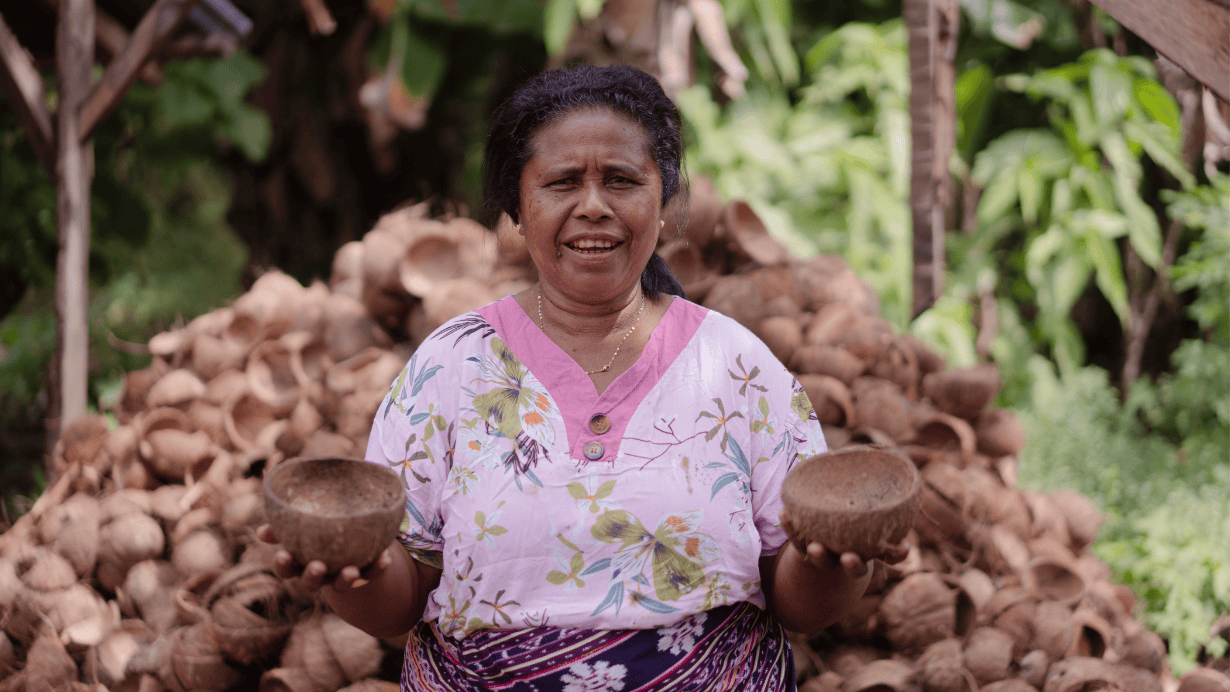
Mrs. Maria Goreti Bunga, one of the participants, shared an example from her own home.
“I did all the housework, everything! But through CIS Timor’s activities, I learned that this work is not fully my right and responsibility. Men can also do it.”
Slowly, she shared this understanding with her husband. After that, her husband began helping with household work.
To outsiders, this may sound simple. But in a household where work has long been divided according to old habits, such a change matters. It shows that training did not stop as a set of materials. It entered the kitchen, the yard, the livestock pen, and conversations between husband and wife.
Mrs. Maria also began to be involved in household economic decisions. Previously, the sale of livestock was handled entirely by men. Now, she can also take part, especially in negotiating livestock prices.
Change in Loko Kalada also touched persons with disabilities. A community that previously often viewed persons with disabilities as powerless began learning to involve them.
Mrs. Maria encouraged the participation of a child with a hearing disability in a CIS Timor activity in 2024. She believed that the child had the right to attend and understand the activity process, despite having limited hearing.
The challenges were clear. Loko Kalada Village did not yet have a sign language interpreter. The activity was also not supported by sign language interpretation. But the participants did not stop there. The materials delivered during the activity were passed on to the child with the help of other participants, despite their limited sign language skills. Information was also shared through the child’s mother and then passed on to the child.
“I went to the child’s house and talked to them so they would join the activity. I told them there was no need to feel ashamed or afraid, but they did not want to join,” said Mrs. Maria.
She continued to provide encouragement. Eventually, the child agreed to participate.
In a village where inclusive facilities remain limited, such efforts matter. They may not yet be ideal, but they open a pathway. They make someone who may previously have been unseen become part of village activities.
Women participants in Loko Kalada also began to find the courage to become indirectly involved in cases of violence against women. In one household case, they sent a man to negotiate so that a woman could be taken to the hospital after she had previously not been allowed to go.
They did it because they felt called to act as fellow women.
In Loko Kalada, solidarity grew from shared experience: women who had once been silent, who had carried heavy burdens, and who slowly learned that they could protect one another.
In Waikaninyo, Women Began Recording Those Who Had Been Unseen
In Waikaninyo Village, patriarchy also remains part of inherited social habits. In household discussions, village meetings, and leadership, women are often placed second.
But those habits are beginning to change.
Men have started fetching water, feeding livestock, and doing other tasks that were previously more often assigned to women. Change is also visible in household decision-making, including when families buy goods or meet food and drink needs at home.
In Waikaninyo, one important initiative came from women who had joined the training. They began collecting data on persons with disabilities in the village. At the time of monitoring, 12 persons with disabilities had been recorded.
This kind of data collection may appear administrative. But in fact, it is political in the most basic sense: it makes those who were previously unseen become visible.
People who are not recorded are often excluded from planning. They do not appear in the data, and then they do not appear in programs. When persons with disabilities begin to be recorded, the door to recognition and support begins to open.
In Waikaninyo, change began with recording. With recognizing. With realizing that justice also means ensuring that no resident disappears from the village’s attention.
Barriers That Still Hold Back Progress
Of course, change in these six villages is not yet complete.
In South Central Timor, men still dominate many village meetings. Women still tend to hand over public affairs to men. In many ways, old habits remain strong.
The participation of persons with disabilities also continues to face challenges. Participants with hearing disabilities need support from sign language interpreters so they can join activities meaningfully. Without that support, participation still depends on the personal efforts of other participants or family members.
Access to basic services also remains difficult. Markets, health centers, and clean water facilities are far from some communities. This distance is not only about kilometers. It is also about time, energy, and burdens that often fall back on women.
Most households also still do not have electricity. All households still cook using firewood. Households that already have electricity may be able to cook rice using electric rice cookers, but firewood is still used to cook side dishes.
In three supported villages in Southwest Sumba Regency, education also remains a barrier. There is still a view that girls do not need to pursue higher education because, after marriage, they will follow their husbands. This view affects women’s confidence and limits their opportunities to develop their capacities.
In other words, change has begun to move, but the old structures have not fully shifted.
From the Household to Village Deliberation
One important lesson from the first year of WE for JET is that social change cannot begin only with policy. It must also enter the household.
Because it is in the household that inequality is often first formed. It is there that children learn who is allowed to sit and who must serve. Who makes decisions and who follows. Who may leave the house and who must complete domestic work.
So when men begin fetching water, it is not merely about helping their wives. When fathers begin taking children to the integrated health post, it is not merely about temporarily replacing someone’s task. When women begin speaking in village deliberations, it is not merely about increasing the number of participants.
All of these are signs that old boundaries are beginning to shift.
The program also shows that awareness-raising on equality between men and women in the household needs to involve both husbands and wives. If only women learn, change can be held back at home. If only men are engaged, women’s experiences may remain unheard. Both need to be part of the same conversation so shared understanding can grow within the family.
Groups of persons with disabilities also need continuous support and training so they can build skills and confidence to participate. Justice is not enough if they are only included on participant lists. They need space, access, and support to be truly involved.
Change That Is Not Yet Big, but Already Meaningful
The first year of WE for JET in CIS Timor’s supported villages shows that change does not always arrive like a large wave. More often, it comes like water seeping through: slowly, quietly, but always finding a way.
In Pene Utara, a man fetched water even after being reprimanded for doing what was considered women’s work. In Umbu Ngedo, women began to lead, form groups, and enter village structures. In Loko Kalada, a woman began speaking to her husband about sharing household work and encouraged a child with a hearing disability to attend an activity. In Waikaninyo, women began recording persons with disabilities so they would no longer be overlooked.
None of this has transformed the villages completely. But it has opened a path.
Because big change often begins with small, repeated acts. Fetching water. Taking children to the integrated health post. Inviting women to village deliberations. Recording persons with disabilities. Realizing that household work does not belong to women alone. Believing that women can also lead.
In WE for JET villages, a just energy transition is slowly taking its most grounded form. It is not only about cleaner energy. It is also about a fairer distribution of care work, voices that are more deeply heard, and village decisions that begin to make space for those who have long sat at the back.
From fetching water to making decisions, change is already underway.
Adapted from CIS Timor’s “Cerita Lapangan Y1” field monitoring document on the first year of the WE for JET Program.