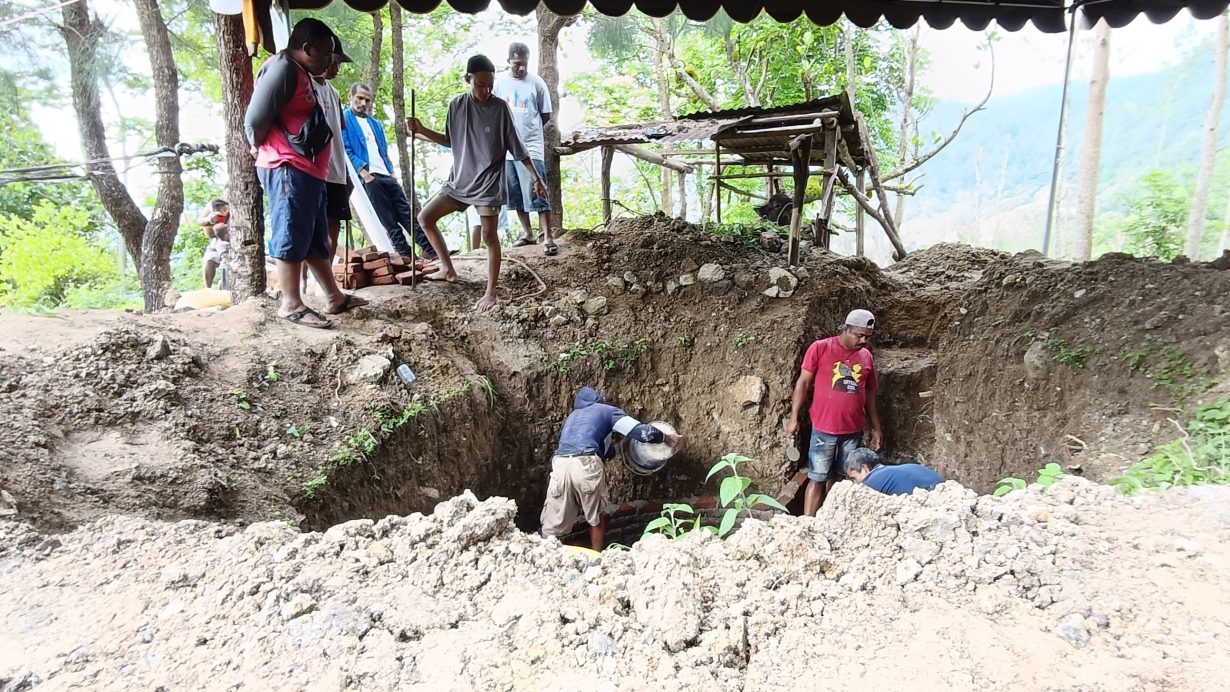



The road to Pene Utara Village is rocky. From the subdistrict town, the distance is about nine kilometers. Along the way, the body follows the rhythm of the uneven stones and dirt road.
But the fatigue slowly fades upon arriving at the home of Mr. Danial Batmalo. His house has bebak walls. The air around it is cool. Pene Utara is indeed blessed with a gentle climate.
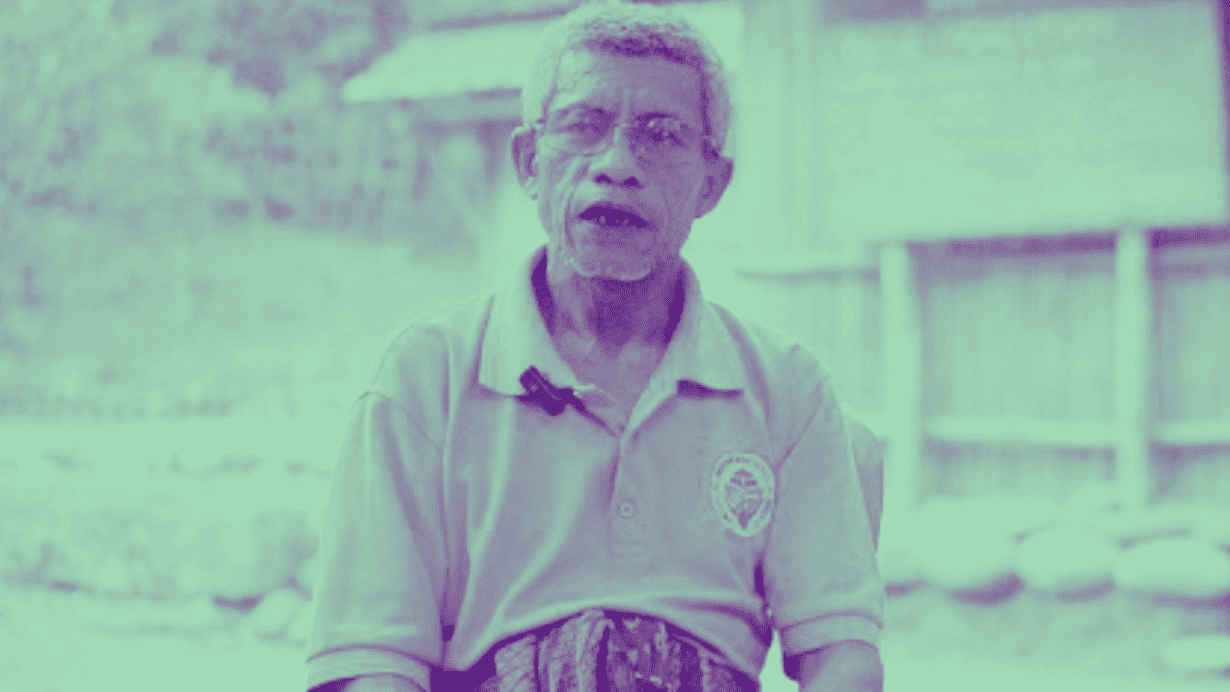
At his home, Mr. Danial welcomed us with a cheerful face. He wore a Pene Utara woven cloth that matched his bright green shirt. While chewing betel nut, he spoke about his village, about change, and about women who are slowly finding space to raise their voices.
He is 59 years old. Yet his body remains strong and agile. He is the Secretary of the Village-Owned Enterprise (Badan Usaha Milik Desa, BUMDes), a Village Facilitator for the WE for JET Program, and the Chair of the Dioskuri Farmers’ Group, which has 16 members. In the church, he is also active as a church elder, or presbyter.
In Pene Utara Village, Oenino Subdistrict, South Central Timor Regency, Mr. Danial is known as one of the local figures driving change. One of the changes he continues to promote is the emergence of women’s leadership in the village.
Pene Utara Village is home to 101 households. To meet their daily water needs, residents collect water from a nearby river, including those living around Mr. Danial’s house. For lighting, residents rely heavily on solar power because electricity has not yet reached the village.
Beyond its cool air, Pene Utara is also rich in natural resources. Tamarind, coconut, copra, corn, rice, and pineapple are among the commodities that support household livelihoods in the village.
Mr. Danial is a father of three and a grandfather of two. His first child holds a degree in mathematics from Nusa Cendana University. His second child graduated from a vocational high school (Sekolah Menengah Kejuruan, SMK), while his third child is currently studying at Niki-Niki Christian Vocational High School (Sekolah Menengah Kejuruan Kristen Niki-Niki, SMK Kristen Niki-Niki).
His involvement in church and village activities has become an important foundation for driving change. This includes a difficult kind of change: encouraging women’s participation in public spaces.
He said that before CIS Timor entered Pene Utara Village, he had already been involved in managing the Village-Owned Enterprise (Badan Usaha Milik Desa, BUMDes) and had received training from World Vision Indonesia (Wahana Visi Indonesia, WVI). WVI also provided training on Just Energy Transition (JET) and gender equality. That experience became an important foundation when he later became active as a WE for JET facilitator in Pene Utara Village and participated in CIS Timor activities.
“We feel that the presence of these organizations has truly brought an important change, especially in how we understand the roles of men and women,” he said while chewing betel nut.
Women Who Used to Sit at the Back
According to Mr. Danial, the culture in Pene Utara has not always provided enough space for women. In meetings, whether related to village government, religious affairs, community affairs, or customary matters, those who usually stand at the front are men.
Women are often considered incapable. Unable. Unfit to be at the front.
As a result, women have long been placed in a secondary position in many village affairs in Pene Utara.
For Mr. Danial, this way of thinking is no longer relevant to the times. The situation began to change after CIS Timor provided training for village facilitators. Through the training, he came to understand that women play an important role in life, whether in government, society, church, or customary affairs.
It is not only men who can take part. Women can too, if they are given the opportunity.
Since 2022 and 2023, as a facilitator, he has received various trainings on gender. He learned that gender roles can be shared and exchanged between men and women. Roles inside the home, such as managing household affairs, and roles outside the home, such as serving the wider community, should not be assigned to only one sex.
He did not keep that knowledge to himself.
The materials he received from the training were brought back to the community. He shared them at the grassroots level, with people in the lowest layers of the community. As a facilitator, he also became involved in village deliberations. In those forums, he spoke about the importance of village policies that support women. He also encouraged the development of appropriate regulations, including village regulations that can protect women.
He hopes that, in the future, these ideas can be accommodated and fully implemented.
When Men Began Fetching Water
Change does not always begin in large forums. In Pene Utara, change is also visible in household work, which was previously almost always done by women.
Men have begun helping their wives collect firewood for cooking. They have begun fetching clean water for cooking, bathing, and washing. They help wash clothes, wash dishes, cook, and even bring babies to the integrated health post (Pos Pelayanan Terpadu, Posyandu). Previously, such tasks were never done by men in Pene Utara Village.
For Mr. Danial, this is an extraordinary change. It is not just talk. There is real evidence.
According to him, a village facilitator must be the first person to set an example for the community. What is said must be consistent with what is done.
“So how can the community learn? We must do it first. We must set the example,” he emphasized.
In Pene Utara Village, there are four village facilitators: two women and two men. They agreed that the men involved in JET must become role models and lead by example.
“We did it first. So we help the women provide what is needed in the household so that they do not face difficulties,” he said.
From the training, Mr. Danial understood that what biologically differentiates men and women is sex. According to him, biological difference is God-given and cannot be changed by time, place, or circumstance. It is related to reproductive organs and sex.
Meanwhile, gender roles and the division of household work can be carried out by everyone, both men and women. Gender roles can change over time and across places.
“So we help the women at home. We do the kinds of work that, perhaps until now, have only been done by women,” he said.
Women Begin to Speak Up
In the community, Mr. Danial has begun to see changes among women. Many women are now involved in village activities. When given the opportunity to speak, they dare to express their opinions and ideas to the village government.
Since 2022, women in Pene Utara have been recruited into the Formulation Team for the Village Medium-Term Development Plan (Rencana Pembangunan Jangka Menengah Desa, RPJMDes) and the Village Government Work Plan (Rencana Kerja Pemerintah Desa, RKPDes). This had never happened before in Pene Utara Village.
In the area of culture, the village government has also begun to agree on involving women in customary activities. Previously, customary spaces were usually occupied only by the government and customary leaders. Now, one more element has begun to be added: women leaders.
According to Mr. Danial, women leaders deserve recognition. From women, all human beings are born, both men and women.
From 2022 to 2025, various activities have begun to involve women. In the past, the first activity was attended only by men. But later activities began to include women. They were given specific training to recognize who they truly are. Women are not only responsible for household duties, preparing food, or giving birth. Women also have roles in community life.
Slowly, many women have become more enthusiastic. Some have even volunteered to be included in future activities.
Women’s School and a New Learning Space
In Pene Utara, there is a program called Women’s School (Sekolah Perempuan, SKOPER), initiated by the Office of Women’s Empowerment and Child Protection (Dinas Pemberdayaan Perempuan dan Perlindungan Anak, DP3A). The program entered the community through the church. According to Mr. Danial, the materials taught in SKOPER are aligned with the materials taught by CIS Timor, particularly on the concept of gender.
The facilitators were asked to become instructors in SKOPER.
“I myself was asked by the female pastor to help two congregations. The task was to deepen the materials for participants in those two congregations. There were tutors prepared by the church, but they asked whether the WE for JET and CIS Timor facilitators could help the existing tutors deepen their understanding of the materials they are now teaching,” he said.
According to him, the materials delivered in SKOPER are exactly the same as those provided in the WE for JET training.
“We are grateful. Our role has not been in vain. It is not that we only gained knowledge and then stayed silent in the village. We have been involved in many things. Now SKOPER knows us very well,” he said.
Mr. Danial was given the opportunity to teach at GMIT Emanuel Tomnanu Congregation and MBSR Penetunan Congregation. GMIT refers to the Evangelical Christian Church in Timor (Gereja Masehi Injili di Timor, GMIT). In the two congregations, he is scheduled to teach twice a week, every Tuesday and Thursday. On Thursdays, he helps the church tutors deepen the materials being taught.
SKOPER has become one of the important entry points for building women’s confidence. There, women learn to recognize themselves and their potential.
“We enter through SKOPER. We educate them first so they know who they really are. So they are not passive. That is our dream,” he said.
Weaving Equality into Natoni
In the village, Mr. Danial is also trusted by the community to serve as a spokesperson during marriage proposal ceremonies. With the gender equality values he gained from training, he brings those messages into customary spaces.
In the proposal process, the spokesperson is responsible for conveying the intentions of one family to another. But for Mr. Danial, the role does not stop at announcing that a man and a woman will marry. Within that moment, there is also space to raise awareness about the importance of women’s roles.
During these proposal ceremonies, values of gender justice can be shared with the families and guests in attendance.
Although natoni is delivered in the local language, Mr. Danial inserts messages about respect for women. Customary forums like these, he believes, are highly strategic spaces for socializing gender-just values.
Two Challenges
Not everything runs smoothly.
Mr. Danial admits that encouraging change in the village is not easy. This is especially true because the change concerns something new: challenging a culture that has long prioritized men.
The first challenge comes from men. For a long time, many matters have been handled by men. Men are considered the ones who must stand at the front. This view is deeply rooted in the community.
To open people’s perspectives, the training was carried out by separating men’s and women’s groups. At the initial stage, only men participated in the activity. There, they were invited to understand that the difference between men and women lies only in biological sex, which is God-given. They were also introduced to the concept of gender. Through this process, awareness began to grow that men are not the only ones who should be prioritized. Women also need to be given equal opportunity.
The second challenge comes from women themselves. Because they have become accustomed to the old situation, some women feel comfortable with it and resist change.
Some feel that those who have long been chosen and trusted to become leaders in the church, such as church elders, or to attend village meetings, are men. They feel unworthy and incapable. They are also reluctant to attend village activities even when invited. For Mr. Danial, this is understandable because it has become a habit.
These two challenges require the facilitators to work harder. They use SKOPER as an entry point to build women’s confidence. Women are encouraged to realize that they have the ability to play roles not only in the household, but also in society.
Another strategy is carried out through village activities. The facilitators propose that more women be invited to every activity. They even encourage around 75 percent of invitations to be given to women.
“We have communicated this with the village government. So we try to make sure more women receive invitations. This is a subtle approach. It means they receive an invitation letter. And because there is an invitation letter, they will clearly attend,” he said.
According to him, in 2024 and 2025, changes began to appear. Women’s participation became increasingly visible.
Women in the Church and Village Planning
During the election of the Church Council for the 2023–2028 period, Mr. Danial served as chair of the committee. In the two congregations, more women than men were recruited as presbyters, elders, and deacons.
According to him, women must be given the opportunity.
“Long before that, we had already socialized this. As chair of the committee, I encouraged people not to let all presbyters be men. If there are women, mothers, or young women who can be chosen as church council members in the roles of elder or deacon, then we should involve them. As a result, in the two congregations in Pene Utara, many women became involved in church leadership positions,” he explained.
In the village government structure, the positions of section heads and hamlet heads are still currently held by men. However, women have begun to be involved in the Formulation Team for the Village Medium-Term Development Plan (Rencana Pembangunan Jangka Menengah Desa, RPJMDes).
“There are women whom we involved in the RPJMDes Formulation Team to help design the programs being implemented in 2024–2025,” he said.
According to Mr. Danial, to see change, the community needs to look back. Before the program entered the village, women in Pene Utara lacked confidence in speaking in front of many people. After the program began, women became more confident. Many women, especially mothers, started to participate in various village activities, although not all women are involved yet.
“That is the change we are experiencing now. Although it is not yet 100 percent, as I said earlier, there are still obstacles and challenges. But little by little, change is happening now,” he said.
The change can be seen in women’s participation in village affairs, church, customary matters, and education. Several women are also involved as members of the Pene Utara Village Sustainable Development Goals Committee (Komite SDGs Desa Pene Utara).
According to him, women’s potential will emerge when they are given the opportunity.
Village Funds and Women’s Groups
In the Village Development Planning Deliberation (Musyawarah Perencanaan Pembangunan Desa, Musrenbangdes), women began to propose that funds entering the village should support women’s empowerment and welfare. From that proposal, women’s groups were formed.
Today, two women’s groups have been established in the congregations: Betlehem Congregation and Ebenhaezar Congregation. From the village side, there is also a group supported by funds from the Family Welfare Movement (Pemberdayaan dan Kesejahteraan Keluarga, PKK) to develop a green kitchen.
In addition, funds have been allocated to support woven cloth production, culinary activities, banana chip processing, and the processing of pineapple and banana wine.
From the village fund, a budget has been allocated through the community empowerment post to support woven cloth businesses, various banana chip products, banana and pineapple wine, and an organic super chicken farming group. Meanwhile, the Family Welfare Movement (Pemberdayaan dan Kesejahteraan Keluarga, PKK) budget supports the green kitchen.
According to Mr. Danial, it is only men’s assumptions that have made women appear incapable. When women are given space and opportunity, they become confident and actively involved in village government activities.
Their abilities emerge because they are given the opportunity. Even though their Indonesian may not be perfect, they dare to speak.
“It turns out that our wives, our village mothers, are capable. But all this time, we have placed them second. When they speak in forums, they are capable. It turns out they are brave. They can speak up, even though their Indonesian is still shaky,” he said proudly.
A Dream from Pene Utara
As a facilitator, Mr. Danial hopes the WE for JET Program will continue to encourage sustainable activities. Collaboration with all parties and institutions in the village needs to continue, especially by involving women.
He wants women not only to carry out domestic and care work such as taking care of children, cooking, washing, and managing the household. He wants women to also become leaders: deputy chair of the church council, members of the Village Consultative Body (Badan Permusyawaratan Desa, BPD), and even village head.
“One day, a woman could become the Head of Pene Utara Village,” he said.
In Pene Utara, that dream may not have fully arrived yet. But the road toward it has begun to open.
It begins with men helping fetch water. With women starting to attend village meetings. With women daring to speak, even if haltingly. With the Women’s School. With the church. With village deliberations. With natoni. With a village facilitator who believes that change must first be practiced before it is spoken.
Little by little, the women of Pene Utara are no longer only sitting at the back. They are beginning to stand, speak, and take their place in the future of their village.